
By Karson Paul
For many high school and college students in the USA, writing the “perfect essay” feels like an enigma. You’ve done the research, gathered the quotes, and your thesis is solid—yet the feedback on your rubric often reads: “Hard to follow,” “Disconnected ideas,” or “Lacks logical flow.”
As an academic consultant, I have reviewed thousands of papers. I’ve found that the difference between a B-grade and an A-grade isn’t just about what you say, but how the reader’s brain processes it. Writing isn’t just about dumping information; it’s about managing cognitive load. When you master the psychology of essay structure , you are “hacking” the grader’s brain to make your arguments feel more persuasive.
How Cognitive Load Affects Your GPA
To understand how to improve essay flow, we must look at Cognitive Load Theory. The human brain has a limited amount of working memory. When a professor reads your paper, they must simultaneously process your vocabulary and integrate new arguments into their existing mental framework.
If your essay lacks a logical structure, the reader is forced to do the heavy lifting. This causes “cognitive friction.” Conversely, when an essay “flows,” it creates a fluency effect—a psychological phenomenon where the reader perceives the information as more truthful and the writer as more competent simply because the information was easy to digest.
3 Essential Parts of an A-Grade Essay Introduction
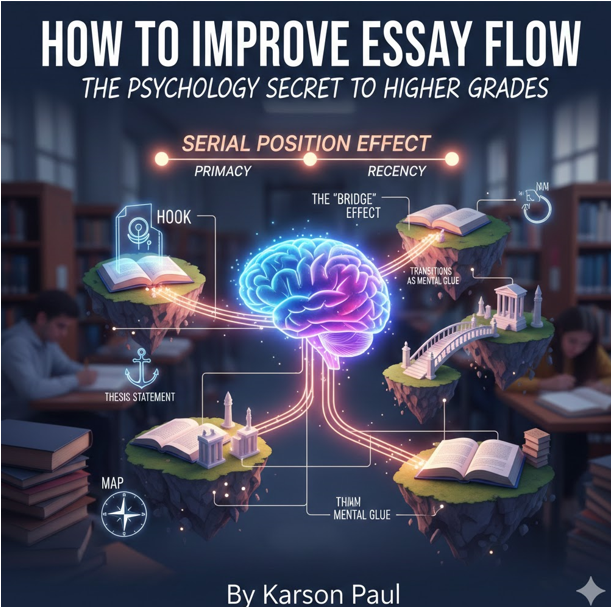
The psychology of a great essay starts with priming. This is the process of preparing the brain to receive specific information. To reduce the reader’s “search effort,” your introduction must act as a psychological map:
- The Hook: Triggers immediate cognitive engagement.
- The Map (Signposting): This is your mental “GPS.” By outlining your main points (e.g., “This essay examines X, Y, and Z”), you ensure the reader’s brain is already expecting those topics, reducing the effort required to follow your logic.
- The Thesis Statement: The “anchor” that serves as the central point of reference for the entire cognitive journey.
The “Bridge” Effect: Using Transitions as Mental Glue
Logical flow is often built in the “white space” between paragraphs. Many students view transitions as filler words like however or furthermore. In reality, transitions are psychological bridges.
Imagine your essay is a series of islands. Without bridges, the reader has to “jump” from one idea to the next. A psychologically sound transition should Look Backward (reference the previous point) and Look Forward (connect it to the next). This creates a “narrative thread” that keeps the grader engaged rather than confused.
Structural Symmetry and the Serial Position Effect
In psychology, the Serial Position Effect explains that people remember the beginning (Primacy Effect) and the end (Recency Effect) of a sequence more clearly than the middle.
To use this for higher essay grades:
- Lead with your strongest argument: Establish authority and expertise immediately.
- Tuck necessary but “dry” points in the middle: Use the middle for required background or counter-arguments.
- End with a “Punch”: Finish your body paragraphs with a strong concluding thought to leave a lasting impression.
Why Professional Guidance is a Smart Strategy
While mastering structure is the “skeleton” of your essay, the “muscles” are the quality of your research and the clarity of your prose. In the high-pressure world of American academia, many students experience “Blank Page Syndrome”—a psychological block caused by high cortisol levels (stress).
Recognizing when you need support is a hallmark of a successful student. Whether you are utilizing structural templates at StructureSpy or seeking expert essay help from the subject matter experts at Myassignmenthelp.com, leveraging professional resources is a smart psychological strategy. It reduces the stress that inhibits creative flow, allowing you to focus on the logical organization that wins high marks.
Conclusion: Flow is a Choice
The difference between a B and an A is rarely about who knows more facts; it is about who respects the reader’s psychology. By using priming, chunking, and mental bridges, you move from being a student who simply “answers a prompt” to a writer who “leads the reader.”
About the Author
Karson Paul is an academic writing expert and educational consultant with over a decade of experience helping students navigate the complexities of higher education. Specializing in cognitive writing strategies and structural logic, Karson’s insights help students bridge the gap between complex research and high-scoring communication.